
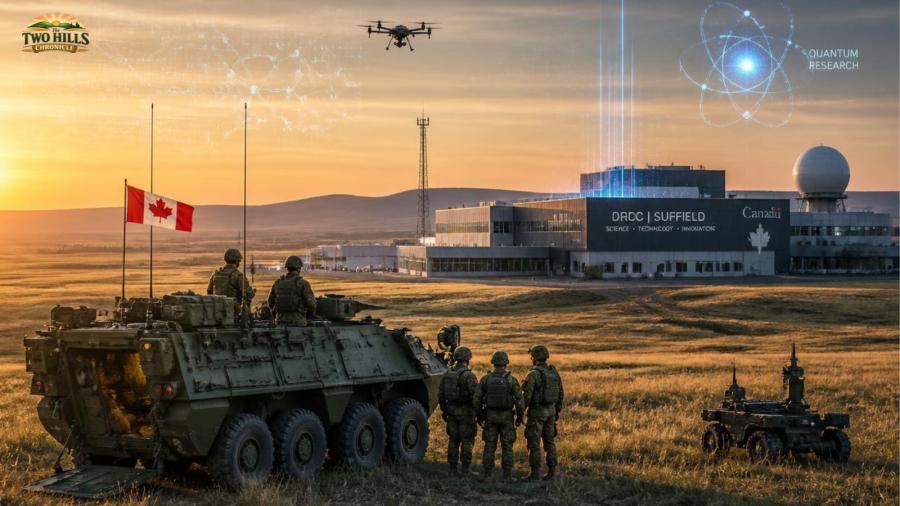
(Image generated using AI)
Alberta is playing an increasingly important role in Canada’s defence and innovation landscape, with military training, scientific research, emerging technologies and infrastructure projects all contributing to the country’s defence capabilities.
That was a key message during a two-day Alberta visit by National Defence Minister David J. McGuinty, who met with Canadian Armed Forces members, researchers, industry leaders and community partners before concluding his tour on August 7.
The visit included stops in Calgary, CFB Suffield and CFB Wainwright, highlighting the range of defence-related activity taking place across the province.
$20.3 Million for Quantum Defence Innovation
During a meeting with Calgary business leaders at the University of Calgary on August 6, McGuinty announced a $20.3 million investment to launch the Quantum Defence Innovation Secure Hub (DISH).
The initiative, operating under the Department of National Defence’s Bureau of Research, Engineering and Advanced Leadership in Innovation and Science (BOREALIS), will provide a secure environment where government, industry and academic partners can collaborate on emerging quantum technologies.
Quantum technology has been identified as one of Canada’s sovereign capability priorities under the country’s Defence Industrial Strategy, with potential applications that could significantly influence future defence capabilities.
“Canada's security depends on our ability to stay ahead of tomorrow's threats,” McGuinty said. “Across Alberta, Canadian Armed Forces members, researchers, innovators, and industry are helping build that advantage.”
Research and Innovation at Suffield
The minister then travelled to CFB Suffield, where he met with reservists participating in summer training and toured the Defence Research and Development Canada Suffield Research Centre.
There, McGuinty met with defence scientists and engineers working on research connected to future Canadian Armed Forces requirements.
Research areas include autonomous systems, counter-uncrewed aerial systems, advanced energetics, and chemical, biological and radiological defence.
The visit also included industry engagement sessions involving QinetiQ, Amtech Aeronautical, UVAD Technologies and Medicine Hat-based Landing Zones Canada.
Landing Zones Canada is receiving advisory services and up to $415,000 through the National Research Council of Canada Industrial Research Assistance Program to advance the defence readiness of its projects and further develop its remotely piloted aircraft system flight-control software.
The federal government says engagement with companies such as these demonstrates the important role small and medium-sized Canadian businesses play in developing innovative solutions to defence and security challenges.
Wainwright and Bold Eagle
On August 7, McGuinty attended the graduation parade for Bold Eagle, an Indigenous summer program operated by the Canadian Army at CFB Wainwright.
The program provides participants with military skills while helping strengthen relationships between the Canadian Armed Forces and First Nations, Inuit and Métis communities.
Bold Eagle began as a 15-candidate pilot program at Camp Dundurn, Saskatchewan, in 1989. Approximately 1,500 candidates have graduated since then.
Following the graduation parade, McGuinty toured CFB Wainwright, including its Military Family Resource Centre.
The base is also undergoing infrastructure improvements. A $12.7 million Energy Performance Contract awarded to MCW Custom Energy Solutions Ltd. will upgrade a number of facilities, with completion forecast for December 2030.
The federal government says the project is intended to improve energy efficiency while modernizing military infrastructure.
Alberta’s broader defence contribution
The minister's Alberta visit brought together several different aspects of Canada's defence strategy—from quantum research and autonomous technologies to military training, Indigenous programs and infrastructure modernization.
It also highlighted the connection between Canada's defence needs and Alberta's research institutions, military bases and private-sector innovators.
“By investing in Canadian talent, cutting-edge technology, and modern military infrastructure, we're strengthening the capabilities our Armed Forces need to defend Canada, support our Allies, and ensure Canada remains strong, secure, and prepared for the future,” McGuinty said.
The visit also comes ahead of a significant change for the Canadian Army. On September 10, 2026, 3rd Canadian Division will be renamed Manoeuvre Division, becoming the Canadian Army's premier warfighting division.
For Alberta, the developments highlighted during the minister's visit demonstrate that the province's contribution to Canada's defence extends well beyond military bases and training grounds. Research, technology, industry and community partnerships are increasingly becoming part of the picture.
(Source: Government of Canada)
