
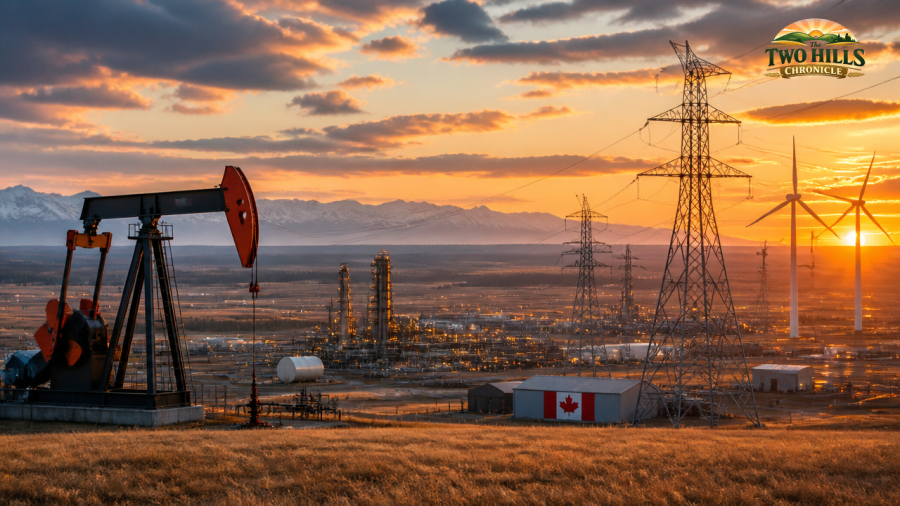
(Image generated using AI)
The federal and Alberta governments have announced a landmark implementation agreement aimed at expanding Canada’s energy exports, reducing emissions and strengthening the economy through new infrastructure, carbon market reforms and electricity investments.
Prime Minister Mark Carney and Alberta Premier Danielle Smith made the announcement in Calgary on May 15, outlining what both governments describe as a cooperative approach to balancing economic growth with environmental goals.
The agreement builds on a Memorandum of Understanding signed in November 2025 and focuses on three major priorities: strengthening carbon markets, expanding clean and reliable electricity generation, and improving access to international energy markets.
Carbon Pricing and Emissions Reductions
As part of the agreement, Canada and Alberta have committed to gradually increasing the effective carbon price to $130 per tonne by 2040, with interim benchmarks of $115 by 2030 and $130 by 2035. The headline carbon price is expected to reach $140 per tonne by 2040.
The governments also agreed to tighten emissions benchmarks under Alberta’s Technology Innovation and Emissions Reduction (TIER) system and establish a minimum floor price for TIER credits beginning in 2030. Officials say the measures are intended to prevent carbon markets from weakening while giving investors greater certainty for long-term projects.
In addition, Canada and Alberta will jointly issue 75 million tonnes of Carbon Contracts for Difference (CFDs), with costs split equally between both governments. The CFDs are designed to encourage investment in emissions-reduction technology and clean energy initiatives.
Federal officials say the broader goal is to create more credible and stable carbon markets while keeping Canada on track toward net-zero emissions by 2050.
Expanding Electricity Infrastructure
The agreement also includes plans to significantly expand Alberta’s electricity grid by 2050.
Both governments say they will work toward increasing electricity generation through a mix of nuclear, wind, solar, geothermal and lower-emission energy sources while maintaining grid reliability.
A joint Electricity Working Group will be established to identify projects and technologies needed to modernize Alberta’s power system and support future economic growth, including the increasing energy demands tied to artificial intelligence and data centres.
The federal government also confirmed support for major upgrades to electricity systems across Canada through its proposed National Electricity Strategy.
Proposed Pipeline to Asian Markets
One of the most significant components of the agreement involves a proposed bitumen pipeline intended to transport at least one million barrels of lower-emission Alberta bitumen per day to Asian markets.
Under the agreement, Alberta will submit a formal proposal for the pipeline project by July 1, 2026. The federal government has indicated it will consider designating the project as being in the national interest under the Building Canada Act by Oct. 1, 2026.
The project would remain subject to consultation requirements with Indigenous communities and further engagement with British Columbia.
Officials say the proposed pipeline is tied closely to the Pathways Project, a large-scale carbon capture, utilization and storage initiative expected to reduce emissions by 16 million tonnes annually while generating billions in economic activity and thousands of jobs.
Leaders Highlight Investment Certainty
In a statement, Carney said the agreement demonstrates that Canada and Alberta are working together to create a more resilient and sustainable economy while streamlining major project approvals.
Smith said the deal sends a strong signal to investors that Alberta and Canada are committed to expanding infrastructure, increasing market access and supporting long-term investment in the province’s energy sector.
The agreement also builds on earlier 2026 deals between Canada and Alberta aimed at creating a “one project, one review” process intended to speed up approvals for major infrastructure developments while maintaining environmental protections and Indigenous consultation requirements.
According to the federal government, the Major Projects Office is currently supporting 22 projects across sectors including nuclear energy, LNG, critical minerals and transportation infrastructure, representing more than $126 billion in proposed investments nationwide.
Information for this article was sourced from the Prime Minister of Canada's website. To view the full release, visit www.pm.gc.ca/en/news/news-releases/2026/05/15/canada-and-alberta-strike-agreement-diversify-our-exports-reduce.
