
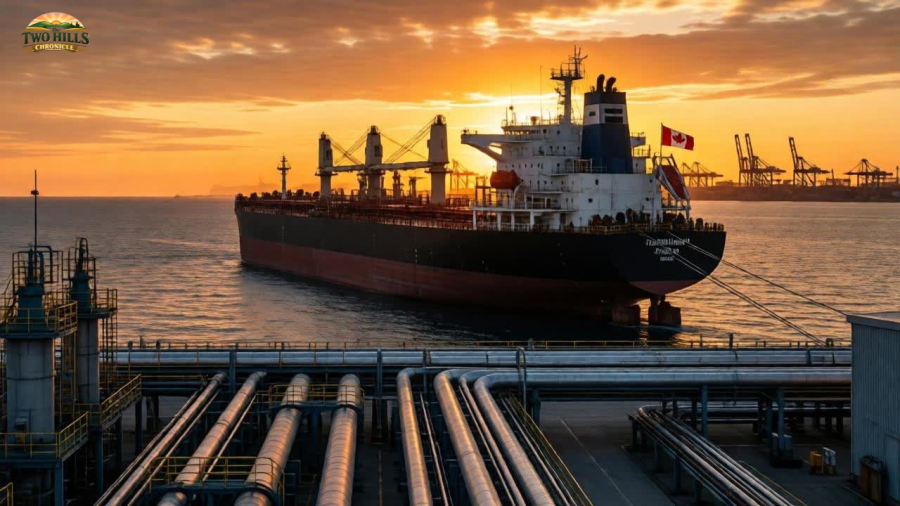
(Image generated using AI)
Alberta is set to significantly expand its presence in Asian energy markets following a new agreement that removes a key trade barrier on crude oil exports to South Korea.
Premier Danielle Smith has signed a joint statement with Myeong-ku Lee, confirming that Alberta’s diluted bitumen qualifies as a Canadian-origin product under existing trade rules. The decision eliminates a three per cent tariff previously applied to Alberta crude entering South Korea.
The move is expected to strengthen Alberta’s competitiveness in Asia while reinforcing trade ties with one of its key economic partners.
In 2025, Alberta exported nearly $400 million worth of crude oil to South Korea—a surge of more than 500 per cent compared to the previous year. With tariffs now removed, projections suggest exports could climb to between $400 million and $1 billion annually, depending on refinery demand.
Smith said the agreement will create new opportunities for Alberta producers while securing long-term demand for the province’s energy.
“This makes Alberta energy more competitive and strengthens a partnership built on reliability and trust,” she said. “It supports investment in our economy and opens the door to sustained growth in exports.”
The agreement also reflects growing cooperation between Alberta and South Korea as both jurisdictions work to strengthen energy security. South Korea, which relies heavily on imported energy, continues to diversify its supply chain, while Alberta aims to expand global access to its oil resources.
According to Lee, the agreement represents a proactive approach to overcoming structural challenges in energy trade.
“It is a significant achievement,” he said, noting that customs authorities played a key role in addressing barriers within the framework of free trade agreements.
Infrastructure has also played a major role in enabling Alberta’s export growth. Trans Mountain Corporation, which operates the pipeline connecting Alberta crude to British Columbia’s coast, has been instrumental in linking Canadian producers to Asian markets.
CEO Mark Maki said the pipeline provides the fastest and most direct route for shipments to Asia. In 2025, more than 65 per cent of exported volumes were delivered to Asian markets from the Westridge Marine Terminal in B.C.
The broader trade relationship between Alberta and South Korea continues to expand. In 2025, total bilateral trade reached $1.8 billion, with Alberta exporting a range of goods including oil, coal, nickel, propane, beef, pork and wood pulp.
Major South Korean refineries—including SK, HD Hyundai Oilbank and GS Caltex—already import Alberta crude, while several Korean energy companies maintain Canadian headquarters in Calgary.
Alberta has also maintained a long-standing relationship with South Korea’s Gangwon State since 1974, underscoring decades of economic and cultural ties.
With tariffs removed and infrastructure in place, Alberta is positioning itself to play a larger role in meeting Asia’s growing energy demands—while driving investment and job creation at home.
Information for this article was sourced from the Government of Alberta website.