
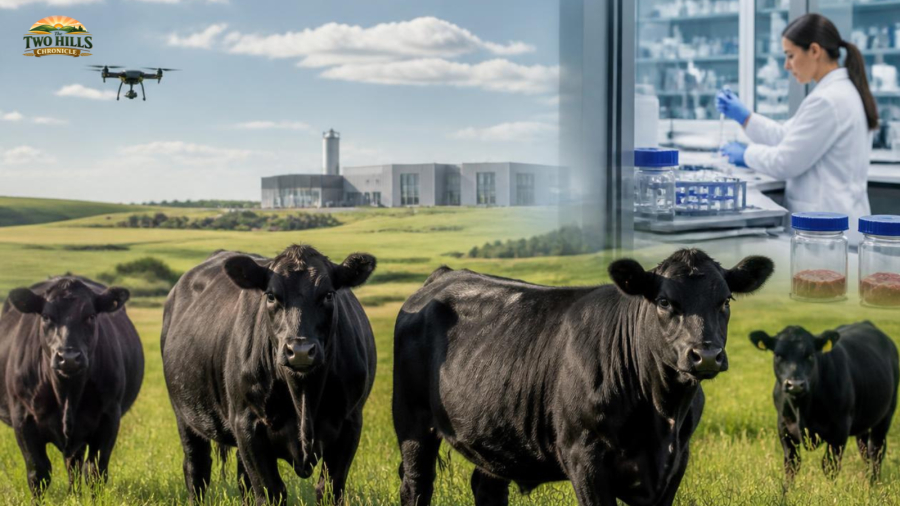
(Image generated using AI)
For Canadian beef producers, research is about more than what happens in a laboratory. The work being funded today can have practical implications for cattle health, production efficiency, food safety and the long-term sustainability of the beef industry.
The Beef Cattle Research Council (BCRC) has released a new collection of research updates highlighting recent results from studies funded through Canadian Beef Cattle Check-Off dollars.
The projects cover a wide range of issues, from antimicrobial resistance and cattle health to sanitation practices at beef packing plants and emerging technologies designed to improve food safety.
Tracking antimicrobial resistance
One of the projects is examining how antimicrobial resistance is changing in bacteria associated with bovine respiratory disease (BRD) in Canadian feedlots.
Researchers are conducting national surveillance to better understand resistance patterns and what those changes could mean for maintaining cattle health and ensuring antimicrobial treatments remain effective.
The research also highlights an often-overlooked practical challenge: timing matters.
Respiratory tract samples collected at feedlots need to reach the laboratory the following day in order to provide useful antimicrobial resistance information.
The information gathered through the project can help researchers and industry better understand how pathogens are responding to antimicrobial treatments and how those treatments can continue to be used responsibly.
Looking for better ways to clean packing plants
Another study is examining whether beef packing plants can improve sanitation while reducing the amount of water and energy required for cleaning.
Researchers looked at how current cleaning practices influence bacterial movement and the formation of biofilms—communities of microorganisms that can attach to surfaces and make sanitation more difficult.
The researchers also tested experimental enzyme-based formulations capable of breaking down fats at lower operating temperatures.
If the technology can be made cost-effective, it could potentially reduce the amount of hot water required for cleaning while maintaining or improving food safety.
Exploring new food-safety technologies
Researchers are also investigating emerging technologies that could help control bacteria and biofilms in beef-processing environments.
Among the approaches being studied are plasma-activated water and ultraviolet technologies.
While additional validation and testing under commercial, field-based conditions is still required, the technologies could eventually provide new tools for controlling foodborne pathogens, improving sanitation and potentially extending beef shelf life.
Taking a closer look at liver abscesses
Liver abscesses are another area receiving attention.
Research indicates that liver abscess development is more complicated than simply identifying a single pathogen or genetic trait responsible for the condition.
Instead, the process appears to involve interactions between gut microorganisms and the animal itself, with the abscesses likely developing later in the feeding period.
Researchers even identified a previously unknown pathogen involved in the process, adding another piece to what remains a complicated puzzle.
Understanding how liver abscesses develop could ultimately help the industry develop better approaches to prevention and management.
The pinkeye puzzle may be more complicated
Pinkeye is another familiar challenge for cattle producers, but new research suggests there may be more to the disease than previously thought.
Researchers found that bacteria commonly associated with pinkeye outbreaks were present in both healthy and infected eyes.
The finding suggests that the disease may involve a more complex combination of factors than simply the presence of the bacteria traditionally blamed for outbreaks.
A better understanding of those factors could help researchers and producers develop more effective strategies for preventing and managing pinkeye.
Investing in the future of Canadian beef
Together, these projects demonstrate the broad range of issues being addressed through beef research in Canada.
From understanding disease and antimicrobial resistance to finding more efficient sanitation methods and exploring new food-safety technologies, research plays an important role in addressing the challenges facing the cattle industry.
The Beef Cattle Research Council says Canadian Beef Cattle Check-Off dollars allocated to research support studies focused on areas including cattle health, pasture productivity, feed efficiency and the production of high-quality beef.
For producers, the value of that research is ultimately measured by whether discoveries can be translated into practical improvements on farms, ranches and throughout the beef supply chain.
Research may begin with questions in a laboratory, but its ultimate goal is helping build a healthier, more efficient and more sustainable Canadian beef industry.
For more information visit the Beef Cattle Research Council website at www.beefresearch.ca/blog/results-are-in-on-animal-health-and-food-safety.
Information for this article is sourced from the Beef Cattle Research Council. To learn more about the BCRC, visit their website at www.beefresearch.ca.
