
(Image sourced from BCRC)
Canadian beef producers heading into breeding season are being encouraged to take a closer look at calving distribution and how tightening calving windows could significantly improve herd performance and profitability.
According to the Beef Cattle Research Council (BCRC), decisions made during breeding season — including when bulls are turned out or removed from pasture — can directly impact next year’s calving season, calf crop uniformity and overall returns.
Calving distribution refers to the percentage of calves born during each 21-day cycle throughout the calving season. Industry targets suggest that at least 60 per cent of females should calve within the first 21 days, followed by 25 per cent in the second cycle, 10 per cent in the third and five per cent in the final cycle. An even more condensed and efficient target is considered to be a 70-20-10 distribution over a 63-day breeding season.
Research continues to show that calves born earlier in the calving season offer major advantages. The BCRC notes that each missed 21-day heat cycle can cost approximately 39 pounds of weaning weight, assuming calves gain an average of 1.85 pounds per day.
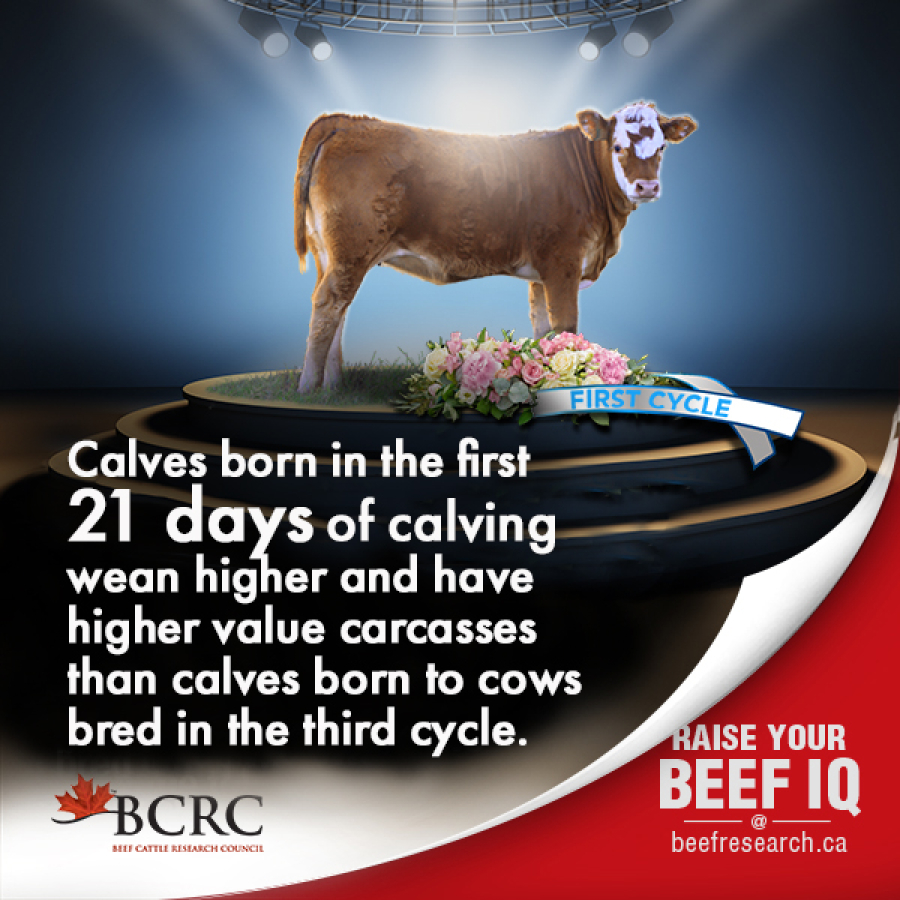
Earlier-born calves not only wean heavier, but also tend to produce higher-value carcasses. Producers also benefit from being able to market larger and more uniform groups of calves.
Data from the 2022–23 Canadian Cow-Calf Survey found that the national calving distribution for cows currently sits near the industry benchmark at 58-26-10-5, with fewer than five per cent of females calving after 63 days.
Long-term research from the Western Beef Development Centre further highlighted the benefits of early calving females. A 16-year study found that heifers calving earlier demonstrated better pregnancy rates, remained in the herd longer and produced an additional calf over their lifetime compared to later-calving females.
The BCRC has also updated its Value of Calving Distribution Calculator, allowing producers to compare their current herd performance against industry targets and estimate the potential financial impact of improving calving distribution.
According to the calculator, increasing the percentage of calves born in the first cycle from 58 per cent to 60 per cent could improve returns by approximately $453. Achieving the ideal 70 per cent first-cycle calving target could increase returns by nearly $5,000.
The organization says producers hoping to improve next year’s calving distribution should begin evaluating their current breeding management practices now and determine what adjustments may be necessary during the upcoming breeding season.
For more information and access to the calculator, visit Beef Cattle Research Council website at www.beefresearch.ca/blog/improve-profitability-with-a-shorter-calving-season/.
Information for this article was sourced from the Beef Cattle Research Council, to find out more about them, visit their website at www.beefresearch.ca.
